Kling 4.0 vs Seedance 2.5: Same Prompt, Three Rounds, Tested Side by Side
Kling 4.0 is the new Kling model Kuaishou released on October 15. Seedance 2.5 is ByteDance's latest video model. Both generate up to 30 seconds in one pass, both come with sound, and both take reference images. On paper they look almost interchangeable, which is exactly why picking one is hard.
We didn't want to hand out an overall score. A single number doesn't help you choose: a skateboard chase and a quiet diner conversation can point to opposite answers. So this Kling 4.0 vs Seedance 2.5 test does one thing. Same prompt, one run on each model, and we look at what comes back.
What each model can do on ZOOOP
First, the settings, so we compare like with like. These are the options ZOOOP actually exposes.
Kling 4.0 (listed as Kling V4 on ZOOOP): 3 to 30 seconds, 720p or 1080p, and 16:9, 9:16, 1:1 or 21:9 framing. Text-to-video takes up to 10 reference images plus one reference video. You can also animate from a start frame to an end frame, or edit an existing clip. Sound is always on; there is no switch.
Seedance 2.5: 4 to 30 seconds, 480p, 720p or 1080p, with 4:3, 3:4 and auto framing on top. It is far more generous with references: up to 30 images, 10 videos and 10 audio clips. Sound can be turned off.
In short, Kling takes fewer inputs but controls each one tightly. Seedance 2.5 lets you pile everything in and adds a cheaper low-resolution draft tier.
How we tested
Three rounds, one English prompt per round. Kling 4.0 and Seedance 2.5 both ran at 720p, 5 seconds, 16:9. Five seconds is short, but it is enough to see how the camera moves, whether a face holds and whether the sound lines up.
Every clip came out of ZOOOP's AI video generator. No cherry-picking: one run per model per round. In the animations below, Kling is on the left and Seedance on the right.
Round 1: motion and a tracking shot
The prompt: a teenage skateboarder in a red hoodie bombs down a steep city hill at golden hour, the camera follows low behind her, swings alongside, and she crouches around a parked delivery van.
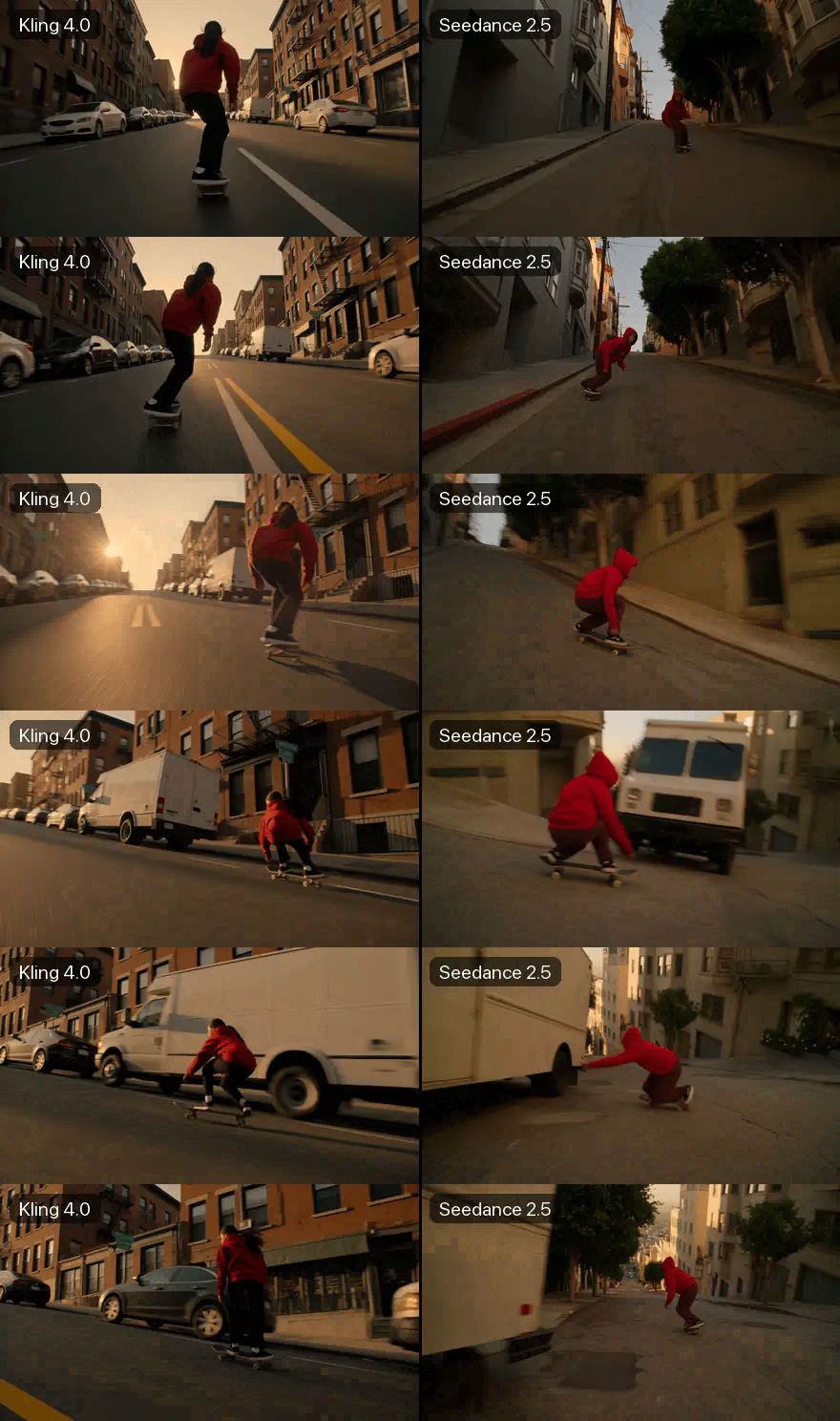
Kling 4.0 delivered one complete tracking shot. The camera pushes in low from behind, drifts around to her side, and never cuts while the van slides past on the right. The motion is on the calm side and the crouch is small, but it shot what we asked for.
Seedance found a steeper hill, a street that looks like San Francisco and a much bigger move: she puts a hand down on the asphalt as she carves past the truck. The catch is that it edited the clip itself, jumping from a wide shot to a side angle to a rear view, like a trailer. It looks great. It just isn't the single tracking shot in the prompt.
On sound, Kling gave a continuous wheel roar and wind; Seedance added a few sharp board slaps.
Round 2: one photo, does the face hold?
For this round we first generated a fictional woman's headshot with GPT Image 2 (grey backdrop, flat light, neutral face) and gave it to both models as the reference. The prompt: she walks through a rainy night market under paper lanterns, buys a grilled skewer, then turns to the camera and laughs.
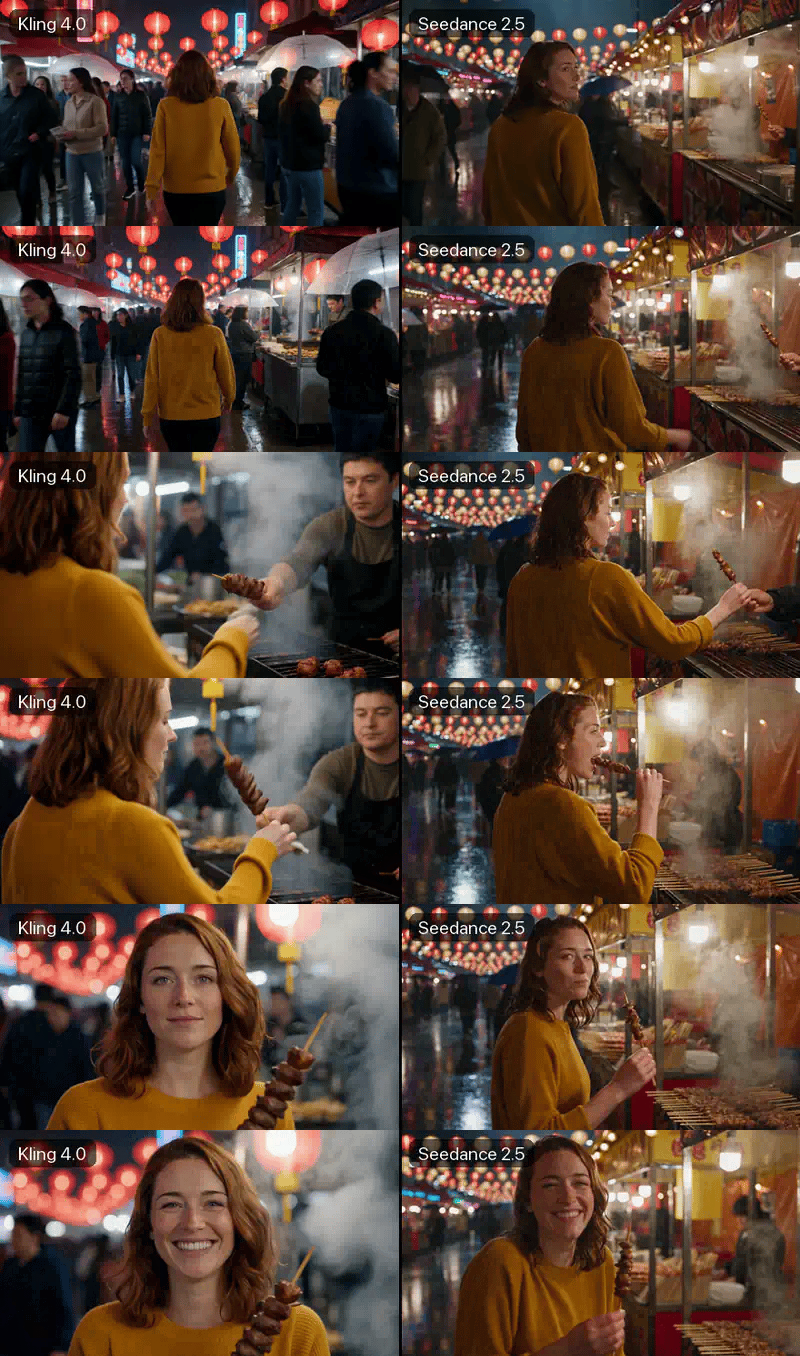
This time the result flipped. Kling cut three shots: a wide view from behind, an over-the-shoulder purchase and a close-up from the front. Seedance stayed in one continuous handheld shot, following her until she bites the skewer.
So "Kling holds long takes, Seedance always cuts" doesn't hold up. Both models decide on their own whether to cut. If you need one unbroken shot, say "one continuous shot" in the prompt.
The faces are clearest in the last frame:
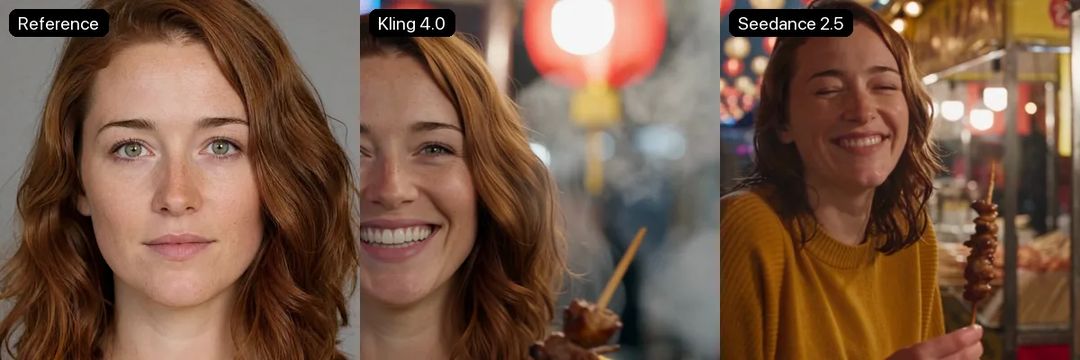
Kling 4.0 is very nearly the woman in the reference: hair color, freckles and eye color all match. Seedance 2.5 is recognizably the same type of person, but her hair turned dark brown with rain and her face got narrower. To be fair, Seedance took the rain far more seriously, and she is actually soaked. In the Kling clip everyone around her carries an umbrella while her own hair stays dry.
Round 3: dialogue and ambient sound
The prompt: a roadside diner on a rainy night. An older man slides an old photo across the table and says, "You kept this all these years?" The woman opposite smiles, picks it up and answers, "Of course I did." Rain, and a coffee cup clinking on a saucer.
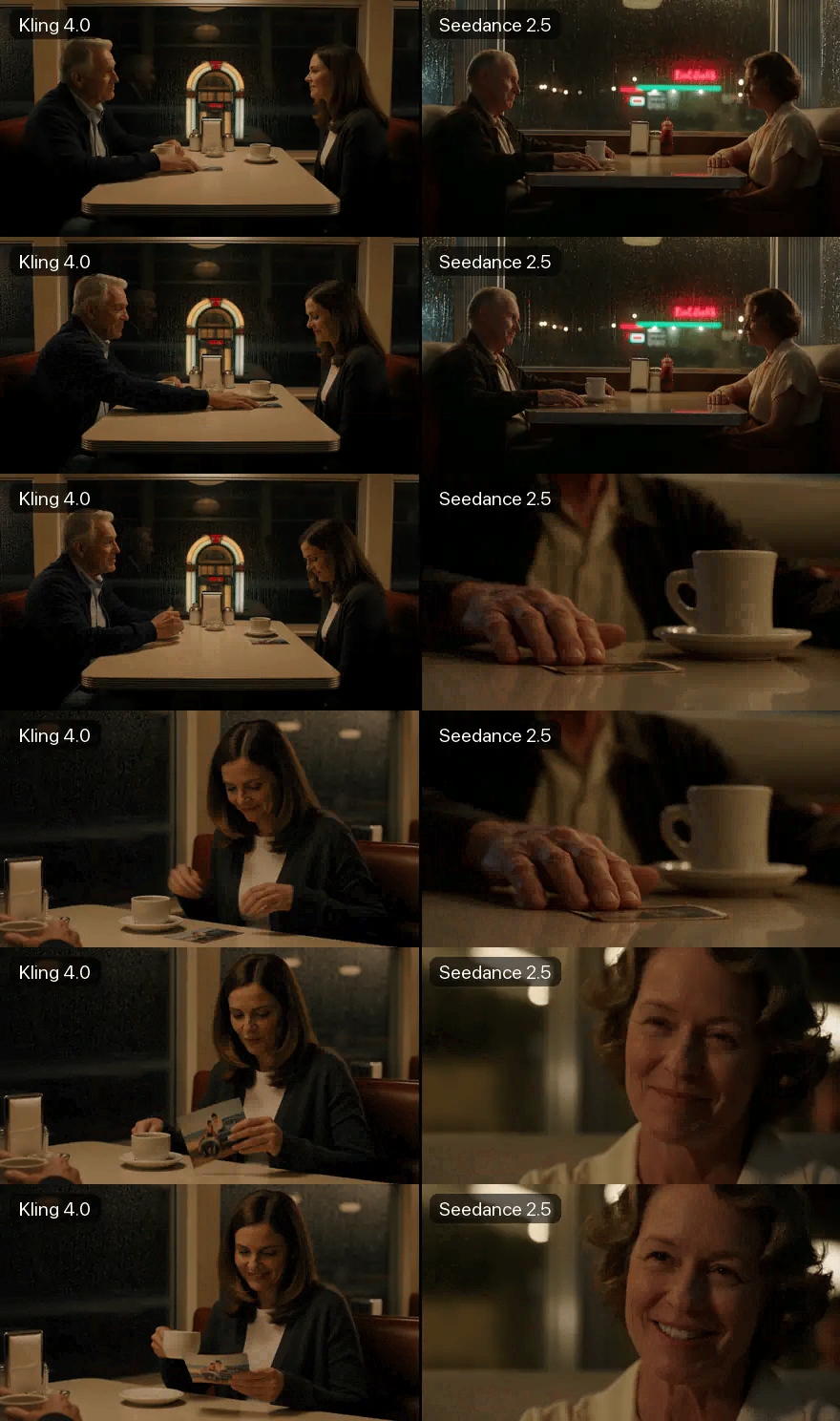
Both models produced a two-line exchange and both cut the scene. Kling 4.0 opens on a two-shot, then cuts to the woman looking down at the photo. Seedance 2.5 adds an insert of a hand on the photo beside the coffee cup and ends on her smile. It also took "all these years" as a cue and made the woman older, which is a nice read of the scene.
Two lines in five seconds is tight, and on both sides the second line lands right at the end of the clip. For dialogue, give it 8 to 10 seconds.
Where each one stumbled
Both had misses:
- Kling ignored "handheld camera following her" in round 2 and cut anyway, and kept her hair dry in the rain.
- Seedance broke the round 1 tracking shot into several cuts, and drifted on the face in round 2 (hair color and face shape).
- Kling offers only 720p and 1080p, with no cheap draft tier, and its sound can't be switched off. If you need silent footage, you'll have to strip it afterwards.
- Seedance edits existing video at up to 720p, while Kling edits at up to 1080p.
On price, Kling 4.0 is clearly cheaper at the same resolution and length, which adds up fast when you iterate.
Which one to pick
So, Seedance vs Kling, scene by scene:
- A long, steady, unbroken shot: Kling 4.0. The round 1 tracking shot was the biggest gap in this test, and "one continuous shot" makes it safer still.
- A face from a photo that has to stay the same person: Kling again. The reference barely drifted.
- A punchy clip that edits itself: Seedance 2.5. It loves to cut, which suits montages and trailers.
- Lots of references, or a voice set from an audio clip: Seedance 2.5, with its 30 images, 10 videos and 10 audio clips.
- Cheap exploration first: Seedance has 480p for rough passes; Kling is cheaper per second, so testing at 720p doesn't hurt either.
- Editing footage you already have: both can do it. Pick Kling for 1080p output and Seedance when you need many reference images.
To run your own Kling 4.0 vs Seedance 2.5 comparison, give the same prompt to both: the Kling 4.0 and Seedance 2.5 model pages let you generate right there. If you already have a start frame, use first and last frame to video; to change existing footage, go to video edit. Both models draw from the same credits, so there's no second account to set up.